What to see in the Algarve from Albufeira – what works as a day trip
Updated September 10, 2026 · 8 min read
Albufeira sits almost exactly in the middle of the Algarve coast. It is a good 90 road kilometres to Cabo de São Vicente in the west, and just under 100 to the Spanish border in the east – you can reach either end in under an hour and a half. If you are based at one end, the other is considerably further: from Tavira to Sagres it is over 140 kilometres.
That is the strongest argument for basing yourself in Albufeira. Almost every sight in the region is a day trip from here, many just a half-day one. This article covers how far each destination is and whether it is worth the trip. For what there is to see in town itself, see What to see in Albufeira.
West, east and inland
Traditionally the Algarve is divided into the Barlavento in the west, the side facing the wind, and the Sotavento in the east. By this division Albufeira just about still belongs to the Barlavento, while the neighbouring municipality of Loulé – which already includes Vilamoura – belongs to the Sotavento. So you are based right on the seam, in the middle of the coast.
Heading west, the rocky coastline with caves and arches continues to Sagres. East of Vilamoura it flattens out, and from Faro onwards long sand islands lie in front of the Ria Formosa lagoon. Then there is the inland region with the Serra de Monchique, whose peak, Fóia, is the highest point in the Algarve at 902 metres.
The A22 motorway (Via do Infante) runs parallel to the coast and has been toll-free since 1 January 2025 – you do not need a toll box in your rental car for it. Tolls still apply on the A2 towards Lisbon. The N125 is the slower alternative, with many roundabouts.
Without a car: not every station is equal
The “Albufeira-Ferreiras” train station is about five and a half kilometres north of the old town. The Giro 11 town bus takes a good 20 minutes to reach Avenida da Liberdade, runs roughly every half hour on weekdays and roughly hourly at weekends and on public holidays – and is not timed to match the trains. If you are coming back in the evening, a taxi is usually the way.
- Good by train: Faro (around 30 minutes, €3.80 one way), Lagos (a good hour with no change, €5.45), Tavira (one to one and a half hours, usually changing at Faro, €6.60). The stations there are 10 to 15 minutes’ walk from the centre. Prices for the regional train, as of July 2026.
- Poor by train: Silves and Loulé. Silves station is about two kilometres outside town, Loulé’s about six. The bus is the better option here.
Vamus’s intercity buses depart from the bus station, about 1.6 kilometres from the old town.
The destinations at a glance
From the old town, by car on the fastest route. In August it often takes longer.
| Destination | km | Driving time | Works as |
|---|---|---|---|
| Zoomarine (Guia) | 12 | 15–20 min | Day out with kids |
| Vilamoura, marina | 17–19 | 20–30 min | Evening or half day |
| Benagil, Praia da Marinha | 25–30 | 30–35 min | Half day |
| Loulé | 30–33 | 25–30 min | Half day |
| Silves | 31–33 | 25–30 min | Half day |
| Carvoeiro, Algar Seco | 35 | 35 min | Half day |
| Faro, old town | 43–46 | 35–45 min | Half day to full day |
| Lagos, Ponta da Piedade | 56–63 | 45–55 min | Full day |
| Monchique, Fóia | 56–63 | 50–65 min | Half day |
| Tavira | 65–70 | 50–55 min | Full day |
| Sagres, Cabo de São Vicente | 89–94 | 75–80 min | Long day |
Silves – the red castle inland
Under Moorish rule, Silves was the capital of the Algarve, and its castle of red sandstone is considered the best preserved in the region. Entry costs €2.80, or €3.90 including the Archaeological Museum (as of 2026, according to Silves town council). In summer it stays open later in the evening. Two to three hours are enough for the castle, cathedral and old streets.
Bus line 17 runs from the bus station directly into town in 45 minutes, but only a few times a day. As a half day, Silves is the best inland destination. Guided tours from Albufeira that include Silves can be found among the things to do in Albufeira.
Loulé – the market hall on Saturday morning
A good 20 kilometres northeast inland as the crow flies, around 30 by road. The draw is the market hall from 1908, with domes in the Moorish style, open Monday to Saturday from 7 am to 3 pm. Saturday is the best day to come, when the farmers’ market adds to it outside; it is busiest in the late morning. Closed on Sundays.
Loulé combines well with the salt mine beneath the town – more on that in Rainy day in Albufeira with kids. Forget the train here; bus line 10 takes around 45 minutes.
Faro – old town, cathedral and lagoon
About 45 kilometres, 35 to 45 minutes via the A22. The train from Ferreiras takes around 30 minutes, and Faro’s station is close to the centre. By car you can park for free on the large Largo de São Francisco on the edge of the old town.
You enter the walled Cidade Velha through the Arco da Vila. At its centre stands the cathedral, from whose tower you look out over the Ria Formosa; entry costs roughly €3.50 to €5 (2026 figures vary), closed on Sundays. Two to three hours are enough for the old town. A full day at Faro only comes together with a boat trip to the lagoon’s islands, which takes several hours.
Vilamoura – a marina, not a sight
Depending on the part of town, 17 to 19 kilometres, 20 to 30 minutes. Vilamoura is a resort built around a large marina, not a sight in the classic sense – an evening on the promenade is enough. Important when booking: some sunset cruises and sailing trips on our pages do not depart from Albufeira but from the marina in Vilamoura.
Benagil, Carvoeiro and the Seven Hanging Valleys
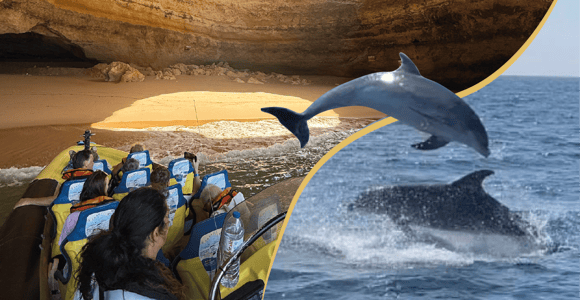
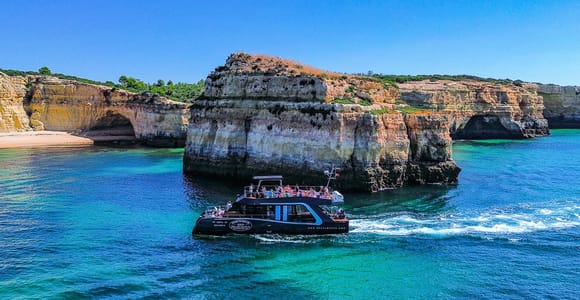
Benagil Cave lies 25 to 30 road kilometres to the west. Whether the boat trip from Albufeira is worth it is covered in Benagil Cave from Albufeira, and which boat gets you inside in Which boat to Benagil?. You will find the trips among the Benagil cave tours, with the three top-rated ones combined with dolphin watching.
By car there are two alternatives. Guided kayak tours that start right on Benagil beach are available from €19.43 – you need to drive there yourself. Or on foot: the Percurso dos Sete Vales Suspensos runs just under six kilometres along the clifftop, from Praia da Marinha past Benagil to Vale Centeanes, two and a half to three hours each way. There is hardly any shade; set off early in high summer and take plenty of water. The car park at Marinha fills up quickly in summer.
In Carvoeiro, a few kilometres further west, a wooden walkway runs along the cliffs to Algar Seco, a rock formation carved out by the sea. Free, a good hour. There is no direct bus from Albufeira.
Lagos and the Ponta da Piedade
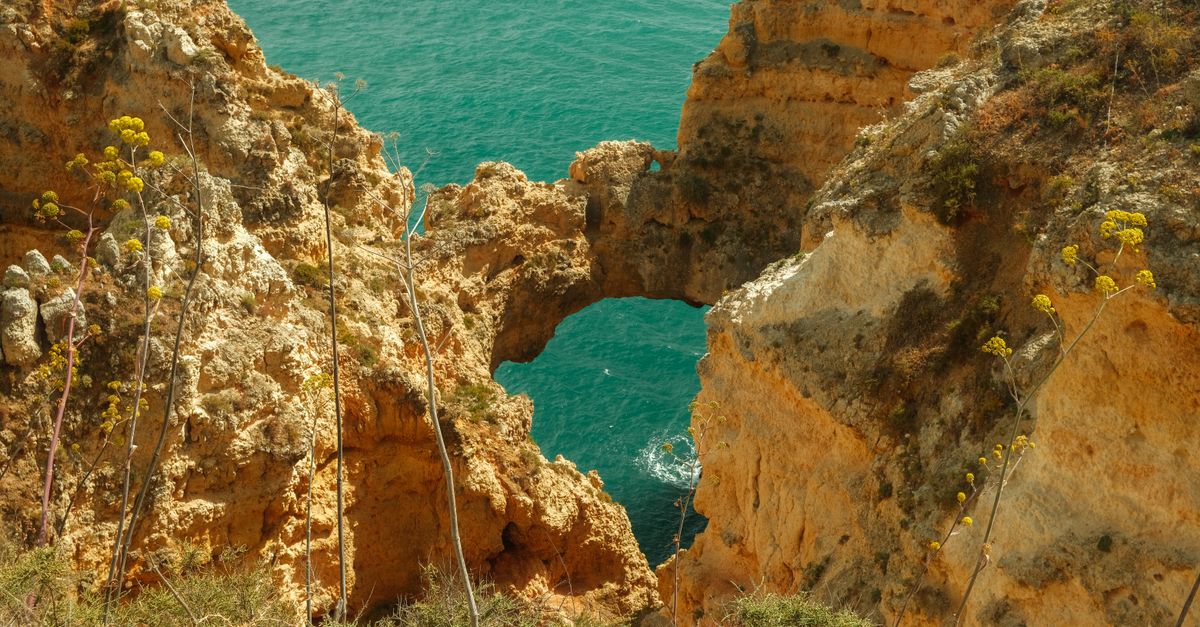
About 60 kilometres, 45 to 55 minutes. The rocky coastline of the Ponta da Piedade, with its pillars, arches and caves, is freely accessible and open at all times. About 180 steps lead down to the water – wear sturdy shoes. It gets crowded at the lighthouse during the day and parking is tight; it is quieter before 10 am or after 4 pm.
Without a car, Lagos is the most convenient far-flung destination: a good hour’s train ride with no change, then a good ten minutes into the centre over a pedestrian bridge. Direct buses take a good one to a good one and a half hours depending on the line. Lagos is a day trip, not a half day.
Sagres and Cabo de São Vicente – better by car
About 90 kilometres, an hour and a quarter. The Sagres fortress has charged €10 entry since 2025, with children up to age 12 free. The cape a few kilometres further on is freely accessible. The naval authority lists the lighthouse as closed to visitors until further notice; according to information from June 2026, that also covers the museum, restaurant and toilets in the complex – check beforehand.
Two limitations: at sunset, the access road and car park at the cape are often overloaded, and after that you face about 80 minutes’ drive home in the dark. And without a car it becomes a slog: train or bus to Lagos, then bus line 47 from there – around three hours each way, with only a few services at weekends, and even fewer to the cape itself.
Monchique and Fóia
The Serra de Monchique is the green, winding counterpart to the coast. It is about 56 kilometres to Monchique, and a good hour to the Fóia summit. In clear weather the view reaches as far as Cabo de São Vicente; in haze you see little. Only reachable by bus with a change in Portimão, and no scheduled bus runs up to Fóia. As a half day it is worth it especially on hot days, as it is noticeably cooler up top.
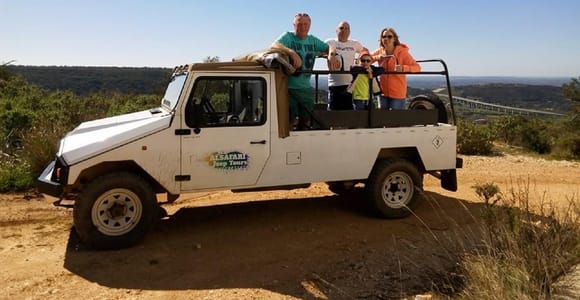
Without your own car, a jeep safari gets you into the nearer inland area; the top-rated one, a half-day tour from Albufeira, costs €40 – more routes among the things to do.
Tavira and the islands in the east
At 65 to 70 kilometres and a good 50 minutes, Tavira is the easternmost destination that is still comfortably worth it from Albufeira. The castle above the Gilão river is free to enter. From the Quatro Águas jetty, about two kilometres out of town, a ferry runs for a few euros to the Ilha de Tavira with its long sandy beach. By train it is one to one and a half hours, usually changing at Faro, then about ten minutes’ walk from the station into the centre. Tavira needs a whole day and is the sharpest contrast to Albufeira.
Water parks and Zoomarine
Zoomarine near Guia, Aqualand in Alcantarilha and Slide & Splash near Lagoa are all no more than half an hour away. Which park suits which age is covered in Albufeira with kids, and for teenagers in Albufeira with teenagers.
What does not work well from Albufeira
- Lagos, Sagres and Monchique in one day – that is a day spent in the car, not at the places.
- Sagres without a car – around three hours each way via Lagos.
- Silves and Loulé by train – both stations are a long way outside town.
- Sunday trips to Loulé or Faro – the market hall and cathedral are closed, and buses run less often.
- The Seven Hanging Valleys at midday in high summer – there is no shade on the clifftop.
In short
With a car: Silves, Loulé and the cliffs around Benagil as half days, Faro, Lagos and Tavira as full days, Sagres only if a long day does not bother you. Without a car: Faro, Lagos and Tavira by train, Silves by bus. None of these destinations is more than an hour and a half away by car – that is Albufeira’s real advantage.